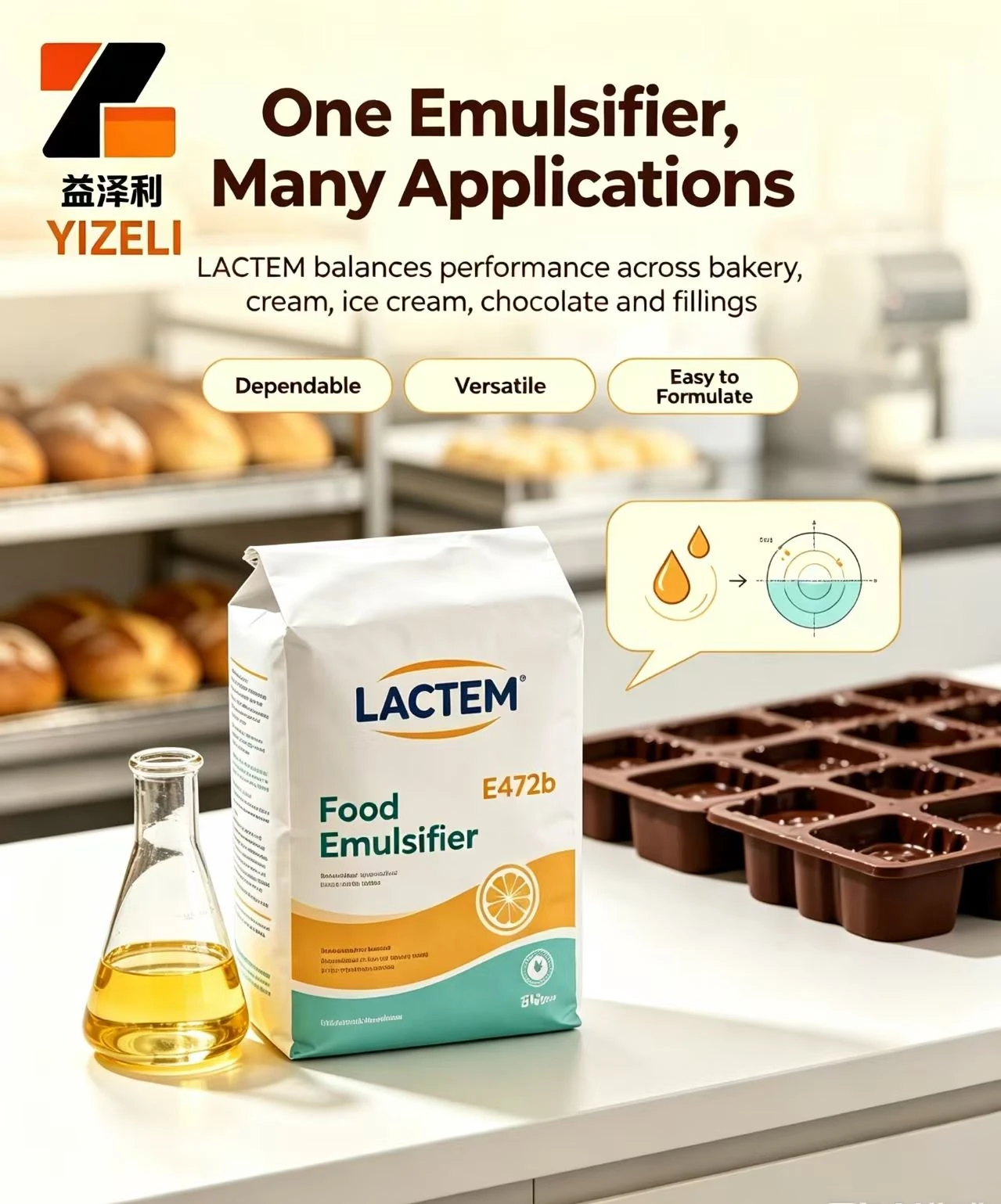
LACTEM doesn't have the dough-strengthening muscle of DATEM, and it can't touch CITREM when it comes to acid stability. It lands somewhere in between. And honestly? That middle ground isn't a weakness-it just means the same emulsifier can handle different jobs on different lines, which is genuinely useful if you're making multiple product types and don't want to keep reformulating.
The molecule itself is made by esterifying mono- and diglycerides with lactic acid. What the lactic acid bit does is make it moderately hydrophilic-so it ends up with a sort of Goldilocks balance. Not too oil-friendly, not too water-friendly. That's exactly why it slots into so many different food systems without throwing things off.
In bakery work, LACTEM makes the dough handle a bit better and helps the fat spread out more evenly. You get a finer crumb, the texture stays softer longer, and staling slows down-maybe not dramatically, but noticeably. In cakes and pastries, it helps the batter hold more air, so you end up with a lighter crumb without having to mess around with the recipe much. Some bakers pair it with monoglycerides to push foam stability further, but plenty find it does the job fine on its own.
We've also seen it pop up in whipped creams and ice cream. With creams, it stabilises the foam and gives you that smooth, consistent texture that just feels right. In ice cream, it tinkers with how the fat crystallises-nudging things towards the right crystal forms so the mouthfeel comes out creamy rather than icy. The effect is there, but it's not shouty about it.
Chocolate and fillings are another area where LACTEM makes an appearance. It drops the viscosity in fat-based coatings, so they flow better during enrobing and moulding. It's not the same as PGPR-you don't get that same punch on yield stress-but it's useful in its own quiet way.
If you're thinking of giving it a go, there are a few practical bits to keep in mind. It dissolves in oils and hot fats, but don't expect it to dissolve in cold water-you can disperse it in hot water if you really need to. Usage usually falls somewhere between 0.1 and 0.5 percent of the formulation, but it does depend on what you're making. Go too heavy and you might start tasting it or get a slightly odd texture, so it's smarter to start low and work your way up. Storage is no big drama: keep it cool and dry, and away from moisture and strong smells.
LACTEM isn't some fancy speciality product, and it doesn't pretend to be. What you get is a solid, middle-of-the-road workhorse. For manufacturers who want one emulsifier that can jump between product lines without constant reformulation, it's a dependable, no-fuss choice.