

Emulsifiers in Cosmetics and Skincare: Decoding the stability code in Formulations
In the development of cosmetics and skincare products, water and oil are inherently immiscible substances, and emulsifiers are precisely the "bridge" that breaks down this barrier. They not only determine the product's physical stability but also directly influence its texture, appearance, and the penetration efficiency of active ingredients.
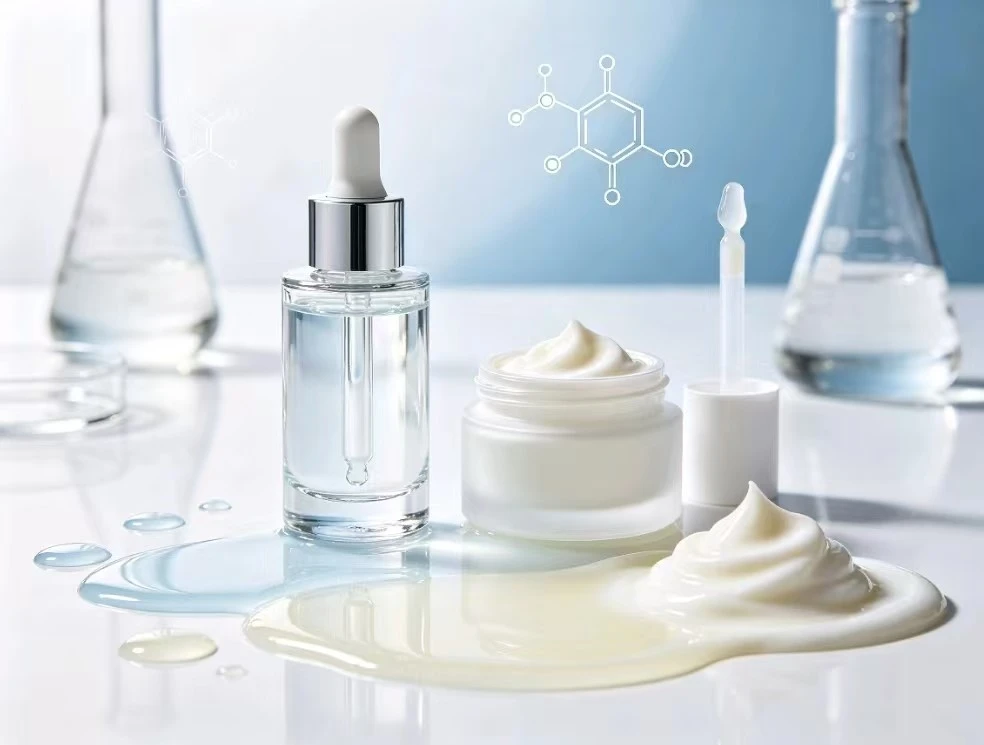
The Key Role of Emulsifiers
In cosmetic and skincare formulations, emulsifiers are far more than simple mixing agents, they are crucial to ensuring product quality. Emulsifiers mainly play the following roles in cosmetic and skincare products:
- Prevent phase separation, ensuring that water-based and oil-based ingredients remain uniformly blended over time, thereby maintaining the product's physical stability and extending its shelf life.
- Emulsifiers directly determine a product's texture and feel on the skin, by adjusting the type and concentration of emulsifiers, formulators can precisely control the product's viscosity, ranging from lightweight serums to rich, restorative creams.
- Furthermore, emulsifiers promote the even distribution and skin penetration of active ingredients, and certain emulsifiers offer additional benefits such as moisturizing, lubricating, or helping to form a protective barrier on the skin.
How to choose the right emulsifier for your cosmetic and skincare products?
When selecting emulsifiers, the hydrophilic-lipophilic balance (HLB) value is a core parameter that formulators must understand. The HLB value typically ranges from 1 to 20 and reflects an emulsifier's affinity for water or oil.
- HLB 3–8 (Lipophilic): Ideal for Water-in-Oil (W/O) emulsions. These provide rich textures and excellent occlusive sealing, perfect for night creams and sunscreens.
- HLB 8–12 (Balanced): Best suited for products requiring a moderate, versatile texture.
- HLB 12–18 (Hydrophilic): The go-to for Oil-in-Water (O/W) emulsions. They deliver lightweight, fast-absorbing finishes, making them perfect for daily lotions and serums.
In actual formulations, blending emulsifiers with high HLB values and those with low HLB values often results in a more stable interfacial film, thereby significantly enhancing the emulsion's stability against temperature changes.
What emulsifiers do we supply for your cosmetics and skincare formulations?
1. Tween Series
Tween (polysorbate) is a class of nonionic surfactants whose molecular structure contains a large number of hydrophilic polyoxyethylene groups. In cosmetics, Tween 20 and Tween 80 are the most commonly used emulsifiers. They possess extremely high hydrophilic-lipophilic balance (HLB) values; for example, Tween 20 has an HLB value as high as 16.7, while Tween 80 exhibits even stronger emulsifying properties.
Applications and Functions:
- Formulation of Oil-in-Water (O/W) Emulsions:
The Tween series is the primary emulsifier of choice for preparing lightweight emulsions and serums, resulting in products with a light texture that are easily absorbed by the skin.
- Powerful Solubilization:
When concentrations exceed the critical micelle concentration, Tween forms micelles in water, "encapsulating" and dissolving hydrophobic substances-such as essential oils and fat-soluble vitamins-that are insoluble in water, resulting in a transparent formulation.
- Formulation Stability and Anti-Aggregation:
In bio-skincare or high-end anti-aging products, Tween also acts as a stabilizer, preventing the aggregation of active proteins and reducing the adsorption of ingredients onto container walls.
2. GMS SE (SE Glyceryl Monostearate)
GMS SE is a nonionic surfactant formed by the esterification of glycerol with stearic acid; with an HLB value of approximately 3.8, it exhibits strong lipophilicity. It serves not only as an emulsifier but also as a multifunctional texture builder in skincare products.
Applications and Functions:
- Synergistic Emulsification and Thickening:
In face creams and body lotions, GMS SE is rarely used alone but is instead formulated as a co-emulsifier in combination with high-HLB emulsifiers. It forms a layered liquid crystal network at the oil-water interface, significantly enhancing the emulsion's viscosity and stability.
- Barrier Enhancement and Moisturization:
The molecular structure of GMS is extremely similar to that of ceramides and fatty acid esters naturally present in human skin. At concentrations of 3–5%, it effectively integrates into the lipid bilayer of the stratum corneum, reducing transepidermal water loss and providing the skin with excellent moisturizing and barrier-repairing effects.
- Sensory Enhancement:
It is the key ingredient for creating a rich, smooth texture, and is widely used in mass-market moisturizers and high-end bridal care creams.
3. Span 80
Span 80 (sorbitan monooleate) is a lipophilic nonionic surfactant with an HLB value of 4.3, it appears as a yellow to brown viscous liquid. As it does not contain polyethylene glycol, it is extremely mild.
Applications and Functions:
- Key Ingredient for Water-in-Oil (W/O) Emulsions:
Span 80 is the core emulsifier for formulating water-in-oil creams, cold creams, and water-resistant sunscreens. It provides excellent occlusive properties, forming a moisture-locking film on the skin's surface.
- Dispersion of Inorganic Powders:
In sunscreen products, Span 80 effectively promotes the uniform dispersion of inorganic UV filters such as titanium dioxide and zinc oxide, preventing clumping and enhancing sun protection efficacy.
- Synergistic Blending:
In actual formulations, Span 80 is often blended with high-HLB emulsifiers (such as the Tween series) in varying ratios to precisely adjust the emulsion type and long-term stability.
4. Polyglyceryl Monooleate
As a member of the polyglyceryl fatty acid ester (PGFE) family, polyglyceryl monooleate is a class of polyhydroxy ester nonionic surfactants. Because the polyglycerol backbone contains more hydrophilic hydroxyl groups, its emulsifying performance is significantly superior to that of traditional monoglycerides.
Applications and Functions:
- Extremely Broad HLB Adjustment and Special Formulations:
By varying the degree of glycerol polymerization, products with HLB values ranging from 1 to 20 can be obtained. It maintains unique emulsifying stability even under acidic conditions at 120°C, making it highly suitable for formulations in alpha-hydroxy acid (AHA) peels or high-salt systems.
- Mildness and Microemulsification:
Polyglyceryl monooleate is non-irritating to human skin and hair and is extremely safe, making it an ideal choice for children's cosmetics and products for sensitive skin.
- Refreshing Skin Feel and Transparency:
It can be blended with specific oils to form microemulsions. When added to water-based serums, it not only preserves the product's transparency but also delivers a luxurious skin feel that is dewy, smooth, and non-sticky.
In addition to regular skincare lotions, emulsifiers also work in some specific product categories. For example, in makeup remover oils, emulsifiers dissolve oily makeup and impurities on the face, then quickly emulsify into a milky-white liquid when massaged with water, allowing them to be easily rinsed off and preventing any greasy residue. In baked hair care or makeup products, emulsifiers also help stabilize bubbles and improve crystal structures.
If you're looking for emulsifiers for your cosmetic and skincare formulations, please do not hesitate to contact us for an inquiry right now!